
SEARCH

The Ultimate Guide to Choosing the Perfect Pizza Trailer for Your Business
Investing in a high-quality pizza trailer is one of the most profitable moves for mobile food entrepreneurs. A well-selected pizza trailer can streamline your daily operations, boost service efficiency, elevate customer experience, and maximize your on-the-go sales. However, with countless sizes, configurations, and custom features on the market, many new business owners struggle to pick a trailer that matches their business goals, menu offerings, and long-term plans. Whether you’re a startup mobile food vendor or looking to upgrade your existing pizza trailer, this comprehensive buying guide will walk you through every key factor to make a smart, cost-effective decision.
1. Define Your Menu & Optimize Workflow Layout First
Your menu and daily service workflow are the foundation of your pizza trailer selection. Every piece of equipment and interior space should be tailored to what you sell and how you work.
Match the trailer to your menu: If you run a specialized pizza business focusing solely on classic and specialty pizzas, a compact, pizza-focused trailer with dedicated oven space and prep areas is sufficient and cost-saving. If you plan to expand your offerings with sides like garlic bread, fries, wings, or beverages, you’ll need a spacious trailer with reserved spots for auxiliary cooking equipment such as fryers, griddles, and drink dispensers. Avoid choosing an overly small trailer that limits your menu expansion, or an oversized one that wastes space and increases operational costs.
Design a smooth workflow layout: A functional interior layout eliminates bottlenecks during peak business hours. A professional pizza trailer should feature separated, dedicated zones: dough preparation area, topping station, high-temperature cooking zone, finished product holding area, and customer serving window. This one-way workflow prevents staff crowding, reduces operational errors, and greatly speeds up order fulfillment, which is critical for busy street markets, festivals, and catering events.
List all essential commercial equipment: Make a full checklist of all required commercial gear before purchasing. Core equipment typically includes commercial refrigerators, freezers for fresh dough and ingredients, stainless steel prep tables, storage cabinets, and warming lights. Always choose mobile-specific, durable appliances that are vibration-resistant, easy to clean, and compliant with food safety standards for outdoor and mobile operations.
2. Pick the Right Pizza Oven & Reliable Power Solution
The pizza oven is the core asset of your trailer, directly determining your pizza taste, cooking speed, and business operation mode. Pairing your oven with a suitable power source ensures stable, efficient, and low-cost daily operation.
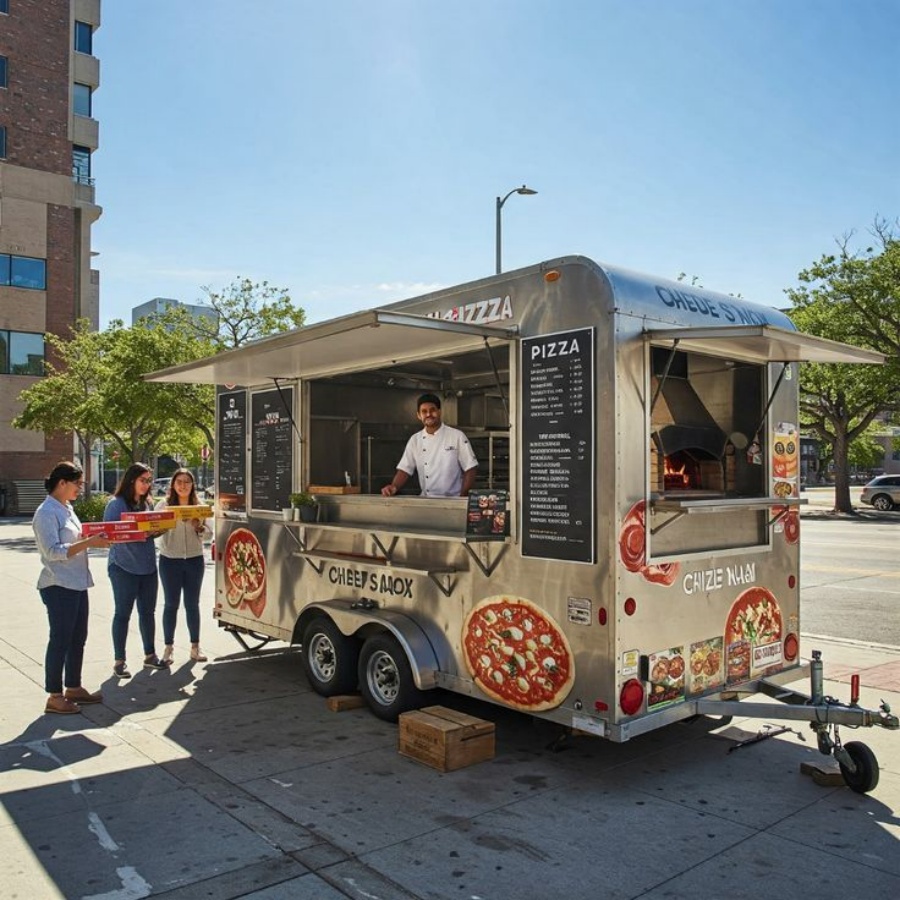
Select your ideal oven type by pizza style: Each oven type has unique advantages to fit different business positioning. Wood-fired pizza ovens deliver authentic, traditional smoky flavors and crispy crusts, perfect for gourmet artisanal pizza brands that pursue high-end taste and customer experience. The only downside is the longer preheating time (4–6 hours) and more frequent cleaning and maintenance. Gas-powered ovens are the most popular option for mobile vendors, featuring fast heating, stable temperature control, and flexible operation for various outdoor scenarios. Electric ovens are eco-friendly, smoke-free, and easy to operate, ideal for urban areas with strict environmental regulations and limited ventilation conditions.
Confirm your power supply mode: Evaluate your main business scenarios in advance. If you mostly operate at fixed locations with stable grid power and gas hookups, you can rely on external power and gas sources to save fuel costs. For off-grid operations such as outdoor fairs, roadside vending, and mobile catering, you need to equip your trailer with a high-power, low-noise generator or sufficient gas tank storage to ensure uninterrupted all-day service.
3. Verify Trailer Specifications & Functional Safety Features
A high-performance pizza trailer must balance size compliance, load capacity, food safety, and all-weather adaptability. Never ignore these technical specifications to avoid operational risks and legal issues.
Check size, weight and regulatory compliance: First, confirm the external dimensions comply with local road traffic and mobile food vendor regulations to avoid towing restrictions. Meanwhile, ensure the internal space fits your workflow and all equipment without overcrowding. Most importantly, check the trailer’s Gross Vehicle Weight Rating (GVWR). The total weight of the trailer, equipment, ingredients, water, and staff supplies must never exceed the rated load capacity to ensure towing safety and avoid mechanical failures.
Complete water and waste sanitation system: Food safety is the top priority for mobile food businesses. A qualified pizza trailer must be equipped with independent fresh water tanks and greywater waste tanks. Standard sanitation configurations including a dedicated handwashing sink and three-compartment sink are mandatory to meet local health department requirements, ensuring standardized cleaning, sanitizing, and food hygiene management.
Adequate storage and refrigeration space: Fresh ingredients are key to delicious pizza. Your trailer needs sufficient cold storage space for fresh dough, vegetables, meats, and dairy toppings, as well as dry storage cabinets for flour, seasonings, and packaging supplies. Reasonable storage layout keeps ingredients fresh, avoids waste, and improves overall operational efficiency.
All-weather climate adaptation: If you operate year-round in diverse weather conditions, choose a fully insulated pizza trailer. Thick insulation layers prevent high-temperature heat buildup in summer and keep the interior warm in cold winter. Equipped with ventilation fans, air conditioning or heating devices, it can protect staff working comfort and more importantly, maintain stable ingredient storage temperatures in all seasons.
4. Plan Long-Term Logistics, Budget & Branding
A successful mobile pizza business requires not only a functional trailer but also reasonable budget planning and unique brand building to stand out in the competitive market.
Make a comprehensive budget plan: Calculate your total investment cost in advance, including the base trailer purchase fee, personalized customization costs (layout modification, equipment installation, system upgrading), and long-term recurring expenses: fuel or electricity costs, regular equipment maintenance, insurance, business permits, and health inspection fees. A complete budget plan helps you avoid overspending and ensure sustainable business profitability.
Build your unique mobile brand image: Your pizza trailer is your mobile outdoor advertising billboard. Exterior branding is a low-cost and high-efficiency way to attract customers. Customize eye-catching exterior wraps with your brand logo, unique brand colors, pizza product pictures, and slogans. A distinctive, clean, and attractive trailer appearance can quickly grab pedestrians’ attention, build brand recognition, and accumulate repeat customers for your mobile pizza business.
Final Thoughts: The best pizza trailer is not the most expensive one, but the one that perfectly fits your menu, operation scenarios, budget, and long-term business goals. By focusing on workflow optimization, oven and power matching, safety specification verification, and brand layout, you can select a practical, durable, and high-value pizza trailer to support your mobile pizza business growth.
Mic Trailers has continually grown and evolved, becoming a leading manufacturer of trailers and trailer accessories.
With a focus on "Pursuit of Excellence, All for Customers,"
Leave a Message
Hey There! Subscribe To Our Newsletter!
No. 2 Zhicheng Road, Duanbolan Town, Qingdao City, Shandong Province, China
Copyright © 2025 Qingdao AMT Trailers Co., Ltd. All Rights Reserved.
 Powered by HiCheng


