
SEARCH

How to Choose a Food Trailer Manufacturer | Global B2B Buying Guide
The global mobile food business continues to create opportunities for entrepreneurs, catering companies, distributors, and established foodservice brands. Food trailers provide businesses with a flexible way to operate at festivals, markets, events, tourist destinations, private properties, and other commercial locations.
For B2B buyers, however, purchasing a food trailer is more than simply finding a trailer at the lowest price.
The right food trailer manufacturer needs to provide a combination of product quality, customization capability, productio experience, export support, and market-specific solutions.
As international buyers increasingly source food trailers directly from manufacturers, understanding what to evaluate before placing an order can help reduce purchasing risks and create better long-term business value.
Modern food trailers are no longer limited to traditional street-food concepts.
Businesses are using customized trailers for:
· Coffee and beverage businesses
· Burgers and fast food
· BBQ and grilled food
· Pizza businesses
· Ice cream and dessert concepts
· Catering services
· Festivals and outdoor events
· Mobile kitchens
· Franchise and brand expansion
· Commercial concession operations
Industry sources covering the 2026 mobile food market also highlight continued opportunities for mobile food businesses, while emphasizing that operators need to manage costs, competition, customer expectations, and operational efficiency carefully.
This changing market means food trailer manufacturers need to offer more than standard trailer models. Buyers increasingly look for solutions that can be adapted to their menu, workflow, brand, and target market.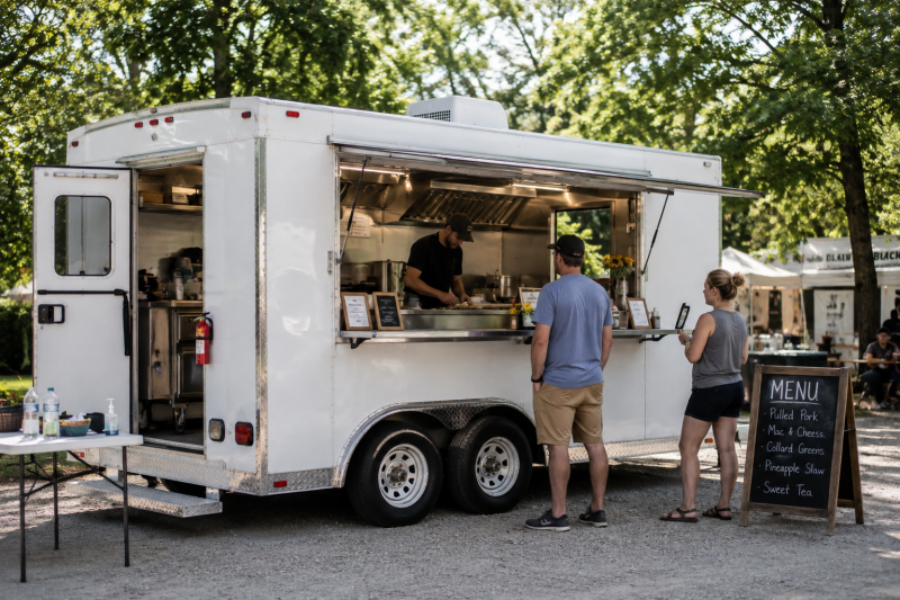
One of the most important factors for B2B buyers is customization.
A standard trailer may not be suitable for every business model. A coffee trailer, for example, requires a different interior layout from a BBQ trailer or a mobile pizza kitchen.
Professional manufacturers can customize areas such as:
The overall dimensions and interior layout should be designed according to the customer's business concept and equipment requirements.
Depending on the menu, a food trailer may require:
· Commercial refrigerators
· Freezers
· Griddles
· Fryers
· Grills
· Ovens
· Coffee machines
· Preparation tables
· Hand-washing sinks
· Storage systems
Electrical capacity, outlets, lighting, water tanks, drainage, and other systems should be planned together with the kitchen equipment.
The trailer itself can become a mobile advertising platform. Exterior colors, logos, service windows, awnings, menu boards, lighting, and other visual elements can be customized to match a brand identity.
A number of international food trailer manufacturers now provide customized layouts and even 2D or 3D design drawings before production, allowing buyers to review the proposed solution before manufacturing begins.
For wholesale buyers and distributors, consistent production quality is critical.
A food trailer may look attractive in product photographs, but B2B buyers should also consider how the trailer is actually manufactured.
Important areas to evaluate include:
· Chassis construction
· Frame strength
· Welding quality
· Exterior materials
· Interior materials
· Flooring
· Doors and windows
· Axles and suspension
· Braking components
· Electrical installation
· Plumbing installation
· Kitchen equipment installation
For commercial food applications, food-grade interior materials such as stainless steel are commonly used because they are practical for cleaning and daily food preparation.
A reliable factory should also have a defined quality-control process covering raw materials, welding, assembly, equipment installation, electrical systems, water systems, and final inspection.
For distributors purchasing multiple units, consistent manufacturing standards become particularly important because every trailer represents part of the distributor's reputation in the local market.
Buying a food trailer internationally involves more than manufacturing.
The supplier should understand the requirements associated with:
· Export documentation
· Packaging
· International transportation
· Trailer identification
· Electrical specifications
· Destination-market requirements
· Customs procedures
· Spare parts
· After-sales support
Different markets may have different technical, road, electrical, food-service, and registration requirements. Recent industry guidance also emphasizes that regulatory requirements can differ significantly between markets such as the United States and European countries.
Therefore, buyers should provide the manufacturer with their destination country and intended application before production begins.
This allows the supplier to discuss the appropriate configuration instead of trying to modify the trailer after it has already been manufactured.
A professional food trailer supplier should be able to discuss the target market during the early design stage.
For example, buyers may need to consider:
· Local electrical voltage
· Plug configuration
· Trailer lighting
· Braking systems
· Road registration requirements
· Kitchen equipment requirements
· Water and drainage systems
· Ventilation
· Fire-safety considerations
· Local food-service regulations
Requirements can also vary within the same country. For example, food-service permits and local health requirements may differ between states, counties, cities, or municipalities.
For this reason, a manufacturer should not simply promise that one standard trailer configuration is suitable for every market.
Instead, the better approach is to establish the customer's destination and requirements first, then design the trailer accordingly.
For importers, wholesalers, and distributors, purchasing directly from a manufacturer can provide several advantages.
A factory-direct relationship may allow buyers to communicate directly with the production team, discuss customization, request technical drawings, and manage larger orders more efficiently.
It can also create opportunities for:
· Wholesale pricing
· OEM projects
· Private-label branding
· Multiple-unit orders
· Customized product ranges
· Long-term supply agreements
· Spare-parts support
For distributors, the ability to develop a unique trailer configuration can also provide an opportunity to differentiate their product offering from competitors selling standard models.
Good communication is often overlooked when buyers compare food trailer suppliers.
However, a customized trailer involves many technical details.
Before production, both sides should clearly confirm:
Trailer specifications → Interior layout → Equipment list → Electrical system → Water system → Exterior design → Branding → Documentation → Shipping method
A professional supplier should be able to provide clear specifications and production information rather than relying only on product photographs.
For larger projects, buyers can also request drawings, production updates, inspection photographs, and final product confirmation before shipment.
This creates a more transparent purchasing process and reduces the possibility of misunderstandings.
A food trailer is a working commercial asset. If an important component fails, downtime can directly affect the customer's business.
For this reason, B2B buyers should consider after-sales support when comparing manufacturers.
Useful support may include:
· Technical documentation
· Installation instructions
· Spare parts
· Equipment information
· Troubleshooting assistance
· Maintenance guidance
· Remote technical support
For distributors, reliable spare-parts availability can also help them provide better service to their own customers.
A manufacturer that supports the product after delivery can therefore become a long-term supply-chain partner rather than simply a one-time seller.
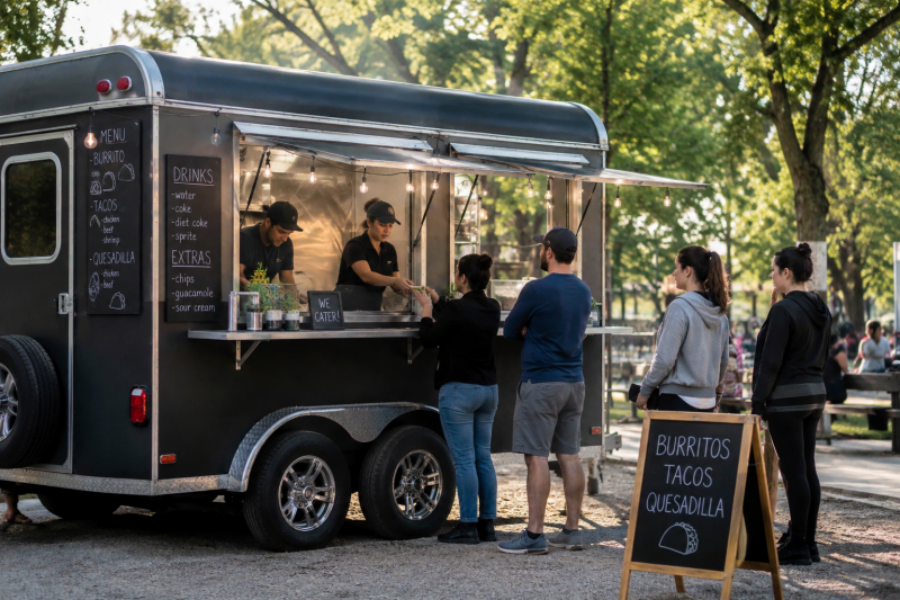
Food Trailer Manufacturing Is Moving Toward Complete Business Solutions
The food trailer industry is gradually moving beyond the traditional concept of simply manufacturing a trailer body.
Today's B2B buyers increasingly want a complete solution that combines:
Trailer + Kitchen Equipment + Layout Design + Branding + Technical Configuration + Export Support
This approach allows manufacturers to become solution providers rather than only trailer suppliers.
For food businesses, the result is a trailer designed around the actual workflow of the operation.
For distributors and importers, it creates an opportunity to offer customers a more complete product package.
Mic Trailers has continually grown and evolved, becoming a leading manufacturer of trailers and trailer accessories.
With a focus on "Pursuit of Excellence, All for Customers,"
Leave a Message
Hey There! Subscribe To Our Newsletter!
No. 2 Zhicheng Road, Duanbolan Town, Qingdao City, Shandong Province, China
Copyright © 2025 Qingdao AMT Trailers Co., Ltd. All Rights Reserved.
 Powered by HiCheng


